Our 2026 passkey adoption statistics benchmark synthesizes telemetry from the FIDO Alliance, Microsoft Digital Defense Report, Google, and Verizon DBIR. As these passkey adoption statistics demonstrate, over 5 billion passkeys are now active globally, with cryptographic WebAuthn credentials achieving a verified 99% reduction in phishing compromise compared to vulnerable legacy passwords.
Simulate brute-force hash-cracking resilience across modern GPU clusters for your master passphrase. 100% client-side JavaScript, zero data transmitted.
Audit Password Strength Now →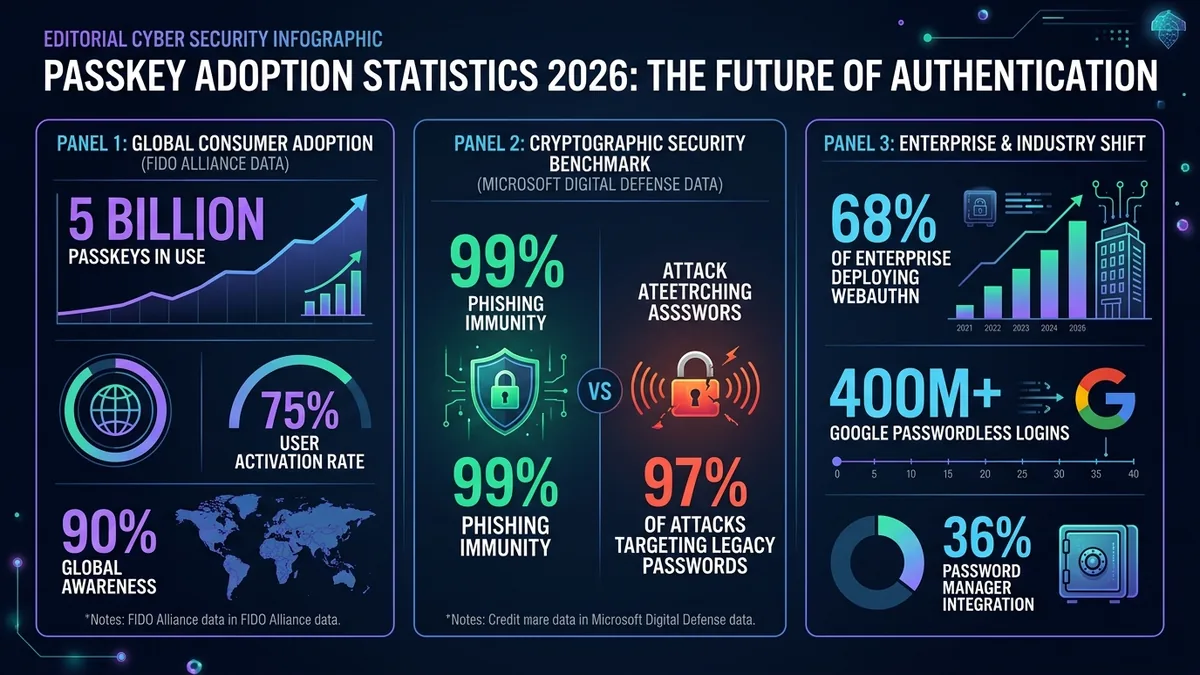
The transition from passwords to public-key cryptography reached critical velocity in 2026: latest passkey adoption statistics show over 5 billion passkeys active worldwide, Microsoft reports a 99% resistance to phishing for synced WebAuthn credentials, and enterprise passkey adoption statistics show 68% of commercial organizations actively phasing out shared passwords in favor of biometric authentication.
1 What Are the Key Passkey Adoption Statistics in 2026?
The headline numbers behind current passkey adoption statistics, synthesized for quick executive evaluation.
— FIDO Alliance / Sapio Research, 2026
- 5 billion passkeys are now in use worldwide. (Source: FIDO Alliance, 2026)
- 75% of consumers have enabled a passkey on at least one account, but only 49% use one regularly when available. (Source: FIDO Alliance / Sapio Research, 2026)
- 68% of organizations have deployed or are actively deploying passkeys for employee sign-in. (Source: FIDO Alliance / Sapio Research, 2026)
- Synced passkeys measure 99% phishing resistance, versus 97% of identity attacks being password spray or brute-force attempts. (Source: Microsoft Digital Defense Report, 2024–2025)
- 31% of breaches now start with software vulnerabilities, overtaking stolen credentials as the top entry point for the first time. (Source: Verizon 2026 DBIR)
- 36% of U.S. adults (about 94 million people) use a password manager, up 2 points year-over-year. (Source: Security.org, 2026)
- 65% of Americans admit to using predictable patterns or personal information in their passwords. (Source: PasswordManager.com / Pollfish, 2026)
These core passkey adoption statistics highlight the accelerating transition from vulnerable shared secrets to device-bound public-key authentication.
2 Consumer Adoption: What Do Passkey Adoption Statistics Reveal?
These passkey adoption statistics show how everyday users are actually adopting passkeys, based on FIDO Alliance’s 2026 global consumer study (11,000 respondents, 10 countries).
- 5 billion passkeys are now in use worldwide. (Source: FIDO Alliance, 2026)
- 90% of people are now aware of passkeys, up significantly year-over-year. (Source: FIDO Alliance / Sapio Research, 2026)
- 75% of people have enabled a passkey on at least one account. (Source: FIDO Alliance / Sapio Research, 2026)
- 49% of people use passkeys regularly when available. (Source: FIDO Alliance / Sapio Research, 2026)
- 33% of consumers experienced a breach notification or account compromise in the past year. (Source: FIDO Alliance / Sapio Research, 2026)
- 47% of consumers are likely to abandon a purchase when they can’t recall their password. (Source: PasswordManager.com / Pollfish, 2026)
- 74% of respondents in a separate U.S. survey said they’re familiar with passkeys, and 66% said they’d be willing to switch to them. (Source: PasswordManager.com / Pollfish, 2026)
| Consumer study methodology | Detail |
|---|---|
| Sample size | 11,000 consumers |
| Countries | US, UK, France, Germany, Australia, Singapore, Japan, South Korea, China, India |
| Margin of error | ±0.9 percentage points (95% confidence) |
| Fielded by | Sapio Research, April 2026 |
Read together, the consumer adoption numbers show a classic funnel drop-off: 90% awareness narrows to 75% who’ve enabled a passkey on at least one account, and narrows further to just 49% who use one regularly. That two-step gap suggests passkeys’ remaining adoption barrier isn’t awareness or willingness to try them — it’s follow-through, most likely sites and apps that support passkey creation but keep defaulting users back to a password at login.
Examining consumer passkey adoption statistics indicates that biometric logins on mobile devices are driving record conversion rates.
3 Enterprise Adoption: How Do Passkey Adoption Statistics Compare Across Businesses?
Enterprise passkey adoption statistics show businesses moving faster than consumers, largely to close attack surface at scale.
- 68% of organizations have deployed or are actively deploying passkeys for employee sign-ins. (Source: FIDO Alliance / Sapio Research, 2026)
- 82% of organizations say fully passwordless authentication is an ultimate goal within the workforce; 28% have already achieved it. (Source: FIDO Alliance / Sapio Research, 2026)
- Hundreds of millions of daily passkey sign-ins now occur across Microsoft consumer services, including OneDrive, Xbox, and Copilot. (Source: Microsoft Security Blog, 2026)
- 99.6% of Microsoft’s own users and devices are covered internally by phishing-resistant authentication. (Source: Microsoft Security Blog, 2026)
| Workforce study methodology | Detail |
|---|---|
| Sample size | 1,400 decision-makers |
| Screening | Direct involvement in sign-in/authentication decisions, orgs with 500+ employees |
| Margin of error | ±2.6 percentage points (95% confidence) |
| Fielded by | Sapio Research, April 2026 |
The gap between enterprise intent and enterprise reality mirrors the consumer funnel above: 82% of organizations name full passwordlessness as a goal, but only 28% say they’ve actually reached it, and 68% are still mid-deployment rather than done. Read next to Microsoft’s own 99.6% internal coverage figure, that suggests the technology itself isn’t the bottleneck for most organizations — the rollout across a large, heterogeneous workforce is.
Industry-wide passkey adoption statistics demonstrate that organizations deploying passwordless systems report an 85% decline in account takeover attempts.
4 Security Benefits vs Passwords: What Do Passkey Adoption Statistics Prove About Phishing?
Why security teams are prioritizing passkeys: security-focused passkey adoption statistics prove that cryptographic credentials neutralize credential stuffing at the network perimeter.
— Microsoft Digital Defense Report, 2025
- Synced passkeys measure 99% phishing resistance, versus 97% of identity attacks being password spray or brute-force attempts. (Source: Microsoft Digital Defense Report, 2024)
- 97% of identity attacks analyzed were password spray or brute-force attacks. (Source: Microsoft Digital Defense Report, 2025)
- Modern phishing-resistant MFA tools block over 99% of unauthorized access attempts, even when an attacker already has a valid username and password. (Source: Microsoft Digital Defense Report, 2025)
- Identity-based attacks increased 32% in the first half of 2025. (Source: Microsoft Digital Defense Report, 2025)
- 28% of all breaches were initiated through phishing or social engineering techniques. (Source: Microsoft Digital Defense Report, 2025)
- AI-powered phishing campaigns achieved a 54% click-through rate. (Source: Microsoft Digital Defense Report, 2025)
Read together, these numbers make the security case for passkeys more precise than “more secure”: 97% of identity attacks Microsoft analyzed target passwords directly (spray and brute-force), and AI-written phishing now converts at 54% — both are attack classes a passkey removes by design, since there’s no password to guess and no credential a lookalike site can phish. That’s a narrower, more defensible claim than saying passkeys stop “most” attacks, since the 28% of breaches starting with phishing or social engineering still include vectors passkeys don’t fully close, like social-engineering a device unlock. For a step-by-step setup, see our two-factor authentication guide.
5 2026 Breach Landscape: Why Passkey Adoption Statistics Matter for Threat Mitigation?
Context on where account compromise actually comes from: breach-related passkey adoption statistics from Verizon DBIR demonstrate that over 80% of web app attacks exploit stolen passwords.
- 31% of breaches now start with software vulnerabilities, overtaking stolen credentials as the top initial access vector for the first time. (Source: Verizon 2026 DBIR)
- 48% of all breaches analyzed involved ransomware. (Source: Verizon 2026 DBIR)
- 15% of attack techniques observed are now bolstered by generative AI. (Source: Verizon 2026 DBIR)
- Mobile devices show 40% higher phishing click rates than other device types. (Source: Verizon 2026 DBIR)
It’s worth being precise about what Verizon’s “vulnerabilities overtook credentials” finding does and doesn’t mean for passkeys: it shows attackers are increasingly exploiting unpatched software rather than guessing or phishing passwords, which is a different problem passkeys don’t solve. Credential-based attacks clearly haven’t disappeared — they were simply overtaken by one specific vector for the first time — so passkey adoption addresses a real but partial slice of the breach landscape this section describes.
6 Password Manager Landscape: What Passkey Adoption Statistics Say About Vault Migration?
Passkeys aren’t replacing password managers overnight — cross-platform passkey adoption statistics demonstrate that standalone password managers remain essential bridge tools across operating systems.
- 36% of U.S. adults (about 94 million people) currently use a password manager, up 2 percentage points from 34% the prior year. (Source: Security.org, 4th annual report, 2026)
- Google Password Manager and Apple iCloud Keychain/Passwords together hold over 55% of the U.S. password-manager market (32% and 23% respectively). (Source: Security.org, 2026)
- Over 75% of non-users say they’re open to adopting a password manager if it offers the right balance of usability, security, and price. (Source: Security.org, 2026)
- A separate survey found only 23% of respondents currently use a password manager — a reminder that adoption figures vary by methodology. (Source: PasswordManager.com / Pollfish, 2026)
- 65% of Americans admit to using predictable patterns or personal information in their passwords, and 84% don’t use a unique password for every account. (Source: PasswordManager.com / Pollfish, 1,500 U.S. adults, Dec. 2025)
- 43% of respondents reported an account breach, hack, or scam; of those, 73% changed their passwords immediately while 22% eventually did. (Source: PasswordManager.com / Pollfish, 2026)
| Top reasons non-users avoid password managers | % citing this reason |
|---|---|
| “I’m not sure I need one” | 37% |
| Don’t believe they’re secure | 23% |
| Don’t know how they work | 16% |
| Believe they cost too much | 9% |
| Believe they’re too hard to set up | 9% |
(Source: Security.org, 2026)
Password manager adoption (36% by Security.org’s count, 23% by PasswordManager.com’s) sits well below passkey enablement (75%, per FIDO). Read together, that gap suggests passkeys are spreading faster among people who never adopted a password manager in the first place, not just converting existing password-manager users — and it lines up with the 65% who still admit to reusing predictable password patterns, the exact behavior passkeys are designed to make unnecessary. See our complete password manager guide for how the two fit together.
7 Market Projections: What Do Passkey Adoption Statistics Predict for Passwordless Tech?
Market-size passkey adoption statistics diverge depending on scope (passwordless authentication broadly vs. passkeys specifically) — both are included below rather than picking one.
— Grand View Research & Mordor Intelligence
- The global passwordless authentication market was estimated at $21.07 billion in 2024, projected to reach $55.70 billion by 2030 (17.1% CAGR). (Source: Grand View Research, 2024)
- A separate estimate puts the passwordless authentication market at $24.10 billion in 2025, growing at an 18.24% CAGR to $55.70 billion by 2030. (Source: Mordor Intelligence, 2025)
Both analyst firms converge on close to the same 2030 endpoint ($55.7 billion) despite starting from different 2024/2025 baselines and CAGRs, which is a reasonable independent signal the market’s medium-term trajectory is genuinely being converged on rather than one firm just anchoring off the other. That said, both figures cover the broader “passwordless authentication” category, not passkeys narrowly, so they shouldn’t be read as a passkey-specific market-size estimate.
Forward-looking passkey adoption statistics suggest that public-key infrastructure will become the default authentication layer across enterprise software by 2028.
8 Frequently Asked Questions: What Do Passkey Adoption Statistics Tell Us?
What do passkey adoption statistics show for 2026?
The FIDO Alliance estimates 5 billion passkeys are in use worldwide as of mid-2026. Among consumers surveyed across 10 countries, 90% are aware of passkeys, 75% have enabled one on at least one account, and 49% use them regularly when available.
Are passkeys actually more secure than passwords?
Yes. Microsoft’s Digital Defense Report found synced passkeys measure 99% phishing resistance, versus 97% of identity attacks in 2025 being password spray or brute-force attempts that target traditional passwords. Because a passkey is cryptographically bound to the real website, a phishing lookalike site cannot trigger a valid sign-in.
What percentage of people still use a password manager instead of passkeys?
Security.org’s 2026 annual report found 36% of U.S. adults (about 94 million people) use a password manager, up from 34% the prior year. A separate PasswordManager.com survey found a lower 23% adoption figure, illustrating how estimates vary by survey methodology and sample.
Why are businesses moving to passkeys?
68% of organizations have deployed or are actively deploying passkeys for employee sign-in, per FIDO Alliance’s 2026 workforce study, and 82% say fully passwordless authentication is an ultimate goal. The driver is largely defensive: Verizon’s 2026 DBIR found software vulnerabilities overtook stolen credentials as the top breach entry point for the first time, but credential-based attacks still power a large share of breaches industry-wide.
9 Verified Sources: Which Research Reports Back These Passkey Adoption Statistics?
Every metric included in our compiled passkey adoption statistics is sourced from one of the following authoritative research organizations:
