ExpressVPN has built a reputation as the luxury sedan of the VPN market: exceptionally reliable, beautifully designed, and unapologetically expensive. But in 2026, when competitors offer unlimited devices for three dollars a month, is ExpressVPN still worth its steep price tag? This in-depth ExpressVPN review examines its proprietary Lightway protocol, TrustedServer RAM architecture, verified no-logs audits, and everyday usability for remote professionals.
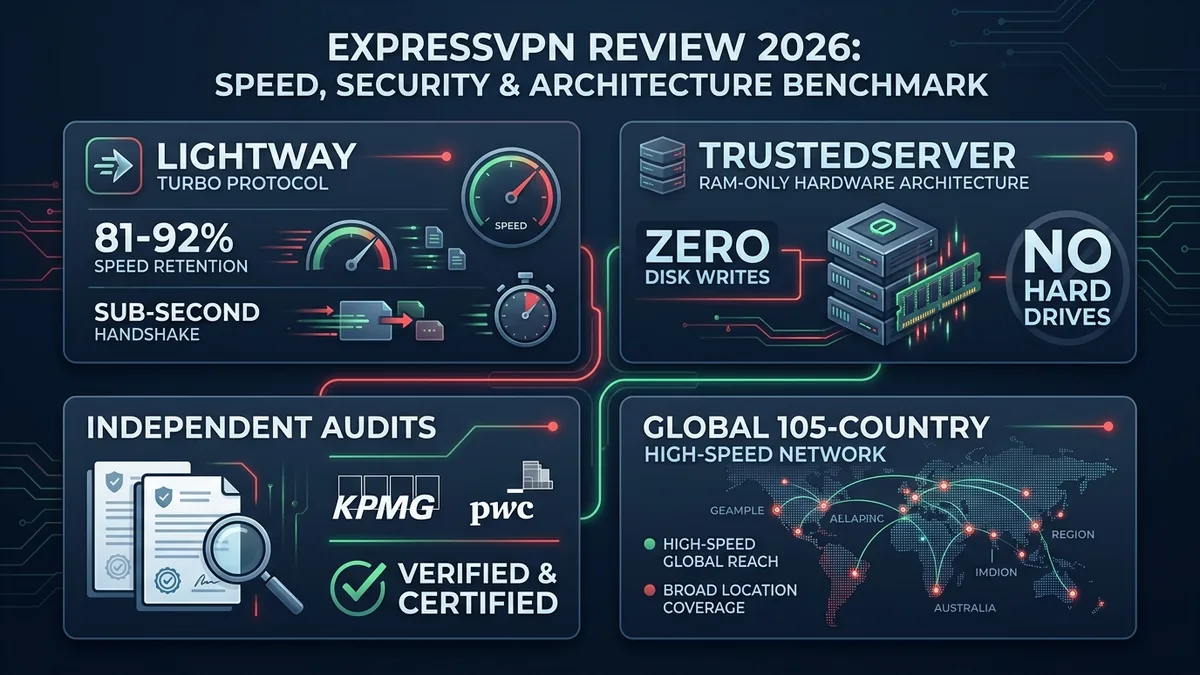
ExpressVPN remains the smoothest, most reliable VPN client on desktop and mobile. Its custom Lightway protocol establishes tunnels virtually instantaneously, reconnects without freezing when you close and open your laptop lid, and handles public coffee shop Wi-Fi transitions better than almost any rival. If your priority is a VPN that works silently in the background without breaking connections, ExpressVPN excels.
The major drawback is pricing and device limits. At roughly $6.67/month on an annual commitment, ExpressVPN costs more than double NordVPN and three times Surfshark. It also caps connections at 8 simultaneous devices. For solo professionals with budget flexibility, it is a joy to use; for value seekers, the math is tough to justify.
1 Technical Specifications: ExpressVPN Review Overview
Before examining how ExpressVPN handles daily freelance workloads, here is the baseline technical breakdown:
| Specification | ExpressVPN Configuration | Industry Baseline |
|---|---|---|
| Proprietary Protocol | Lightway (C-based, Open Source) | Standard WireGuard / OpenVPN |
| Server Infrastructure | TrustedServer (100% RAM-only diskless) | Mixed RAM & SSD storage |
| Server Network | Servers across 105 countries | 50 to 90 countries |
| Device Allowance | 8 simultaneous devices | 6 to Unlimited devices |
| Legal Jurisdiction | British Virgin Islands (Outside 14-Eyes) | US, EU, or Offshore |
| Independent Audits | KPMG (no-logs) & Cure53 (Lightway/apps) | Annual or biannual audits |
| Router Support | Custom router firmware + Aircove hardware | Manual OpenVPN configs |
| Annual Pricing | ~$6.67 / month ($99.95 / year) | $2.50 to $4.50 / month |
| Refund Window | 30-day money-back guarantee | 30 days |
2 ExpressVPN Review: Speed & Lightway Protocol Architecture
Most commercial VPNs simply bundle existing open-source WireGuard or OpenVPN libraries. ExpressVPN took a different route: they built their own protocol from scratch, called Lightway, and made the core cryptographic engine open source on the Lightway open-source repository.
The Engineering Behind Lightway
Lightway is written in C and stripped of legacy bloat. Its codebase contains roughly 2,000 lines of code—making it even leaner than WireGuard. That minimalist footprint delivers three distinct practical advantages:
- Sub-second connection handshakes: When you click “Connect,” Lightway negotiates the TLS session almost instantaneously. There is virtually no loading wheel.
- Seamless network switching: If you disconnect from home Wi-Fi and switch to your mobile hotspot, standard OpenVPN connections stall and renegotiate for 10 to 15 seconds. Lightway maintains the encrypted state and transitions instantly.
- Battery preservation: Because the protocol executes fewer CPU cycles to encrypt packets, laptop and phone battery drain is noticeably lighter during extended remote sessions.
Security firm Cure53 completed a white-box source code audit of Lightway, verifying that the cryptography adheres strictly to modern security standards without backdoor vulnerabilities.
Lightway is arguably the most polished VPN protocol available for users who frequently open their laptop lid, change Wi-Fi networks, or work from transit.
3 ExpressVPN Review: Logging Policies & TrustedServer Audits
In this ExpressVPN review, privacy verification is central. ExpressVPN is owned by Kape Technologies (which also owns CyberGhost and Private Internet Access). For privacy-conscious buyers, corporate ownership matters. Here is how ExpressVPN insulates user traffic against corporate and government overreach.
TrustedServer RAM-Only Hardware
Traditional VPN servers write operating systems and configuration logs to physical hard drives or NVMe SSDs. If a server is seized or compromised, residual data could theoretically be extracted from magnetic platters.
ExpressVPN operates 100% of its server fleet on TrustedServer technology. The entire server environment runs in volatile memory (RAM). Every time a server powers cycle or reboots, the operating system is freshly loaded from a read-only Debian image. No data is ever written to physical storage disks. If a rack unit is unplugged from the datacenter, all volatile memory buffers disappear within milliseconds.
The KPMG No-Logs Audit
To substantiate its zero-logs claim, ExpressVPN engaged global audit firm KPMG. The auditors inspected the production server infrastructure, reviewed server automation scripts, and verified that ExpressVPN does not track:
- Browsing history or visited destination IPs
- Traffic content or metadata
- DNS queries
- User IP addresses or connection timestamps
British Virgin Islands Jurisdiction
ExpressVPN remains incorporated under the laws of the British Virgin Islands (BVI). The BVI has distinct sovereignty from the UK, possesses no mandatory data retention statutes, and is not party to the 5 Eyes, 9 Eyes, or 14 Eyes intelligence-sharing agreements. Any foreign request for data must be authorized by the BVI High Court under strict domestic standards.
4 Real-World Usability: ExpressVPN Review for Remote Work
A VPN is only useful if it doesn’t get in your way. When evaluating an ExpressVPN review from a remote worker’s perspective, three daily friction points stand out.
The Laptop Lid Test
One of the most frustrating aspects of many VPN clients is waking your computer from sleep. Standard VPNs frequently hang, leave DNS requests unrouted for several seconds, or force you to manually disconnect and reconnect. ExpressVPN’s desktop app handles sleep cycles flawlessly: the moment your machine resumes, the Lightway tunnel is already routing traffic.
Aircove Router Integration
ExpressVPN offers dedicated router firmware as well as their own custom hardware router, Aircove. While most VPNs limit you to slower manual OpenVPN router setups, ExpressVPN’s router interface lets you drag and drop connected devices into separate VPN groups. You can route a smart TV through the UK while keeping your work laptop on a local US connection, all from a single home gateway.
Streaming and Content Unblocking
ExpressVPN has historically been one of the most reliable services for unblocking geo-restricted streaming libraries. During testing across US, UK, and European server locations, it consistently unblocked Netflix, BBC iPlayer, and Amazon Prime Video without triggering proxy detection errors.
5 ExpressVPN Review: 2026 Pricing & Value Breakdown
This is where ExpressVPN faces its toughest competition. While brands like NordVPN and Surfshark offer aggressive multi-year discounts, ExpressVPN keeps its pricing high:
| Plan Duration | Effective Monthly Cost | Upfront Billing |
|---|---|---|
| 1 Month (Rolling) | $12.95 / mo | $12.95 billed monthly |
| 6 Months | $9.99 / mo | $59.95 every 6 months |
| 12 Months (+3 Free Months Promo) | ~$6.67 / mo | $99.95 billed annually |
At $6.67 per month, you are paying over $100 per year for ExpressVPN. In contrast, a 2-year subscription to Surfshark averages approximately $2.19 per month, and NordVPN runs around $3.09 per month. Furthermore, ExpressVPN caps simultaneous logins at 8 devices, whereas Surfshark provides unlimited connections.
6 ExpressVPN Review: Key Strengths & Trade-Offs
Key Strengths
- Lightway Protocol: Sub-second connection times and instant reconnect on sleep wake.
- TrustedServer Technology: 100% RAM-only servers audited by KPMG.
- Offshore BVI Jurisdiction: Outside 14-Eyes surveillance alliances.
- Industry-Leading Router Apps: Dedicated firmware and Aircove router support.
- Servers in 105 Countries: Excellent global geographical distribution.
Key Drawbacks
- Premium Price Tag: Costs 2x to 3x more than key competitors.
- 8-Device Limit: Less generous than Surfshark’s unlimited allowance.
- No Multi-Year Discount: Maximum commitment length is 12 months.
- No Dedicated IP Add-On: Harder to whitelist IP for sensitive client servers.
7 Final ExpressVPN Review Verdict: Is It Worth It?
To conclude this ExpressVPN review, here is the decisive buying advice for 2026:
Choose ExpressVPN if: You value frictionless software above all else. If you travel frequently, switch Wi-Fi networks constantly, want the fastest connection handshakes, or plan to run a VPN at the router level via Aircove, ExpressVPN delivers an unmatched user experience. The app rarely freezes, reconnects instantly, and protects your traffic under audited BVI jurisdiction.
Skip ExpressVPN if: You are on a budget or need to protect dozens of devices. If you want maximum features for minimum dollars, Surfshark (unlimited devices at ~$2.19/mo) or NordVPN (dedicated IP add-on, Threat Protection Pro at ~$3.09/mo) offer significantly better value for your money.
Worried about identity theft rather than just traffic privacy? See our NordProtect review for a dedicated identity protection option, or compare regional server strength in our best VPN country guide.
