This ProtonVPN review 2026 starts with a simple observation: in a VPN market flooded with corporate roll-ups and aggressive affiliate hype, Proton VPN stands out by doing the exact opposite of its rivals: it publishes 100% of its client code as open source, operates under strict Swiss data privacy laws, and refuses to run intrusive ads. But how does that uncompromising privacy posture translate to daily freelance productivity? This comprehensive Proton VPN review breaks down its Secure Core architecture, Securitum security audits, VPN Accelerator engineering, and real-world value for remote workers in 2026.
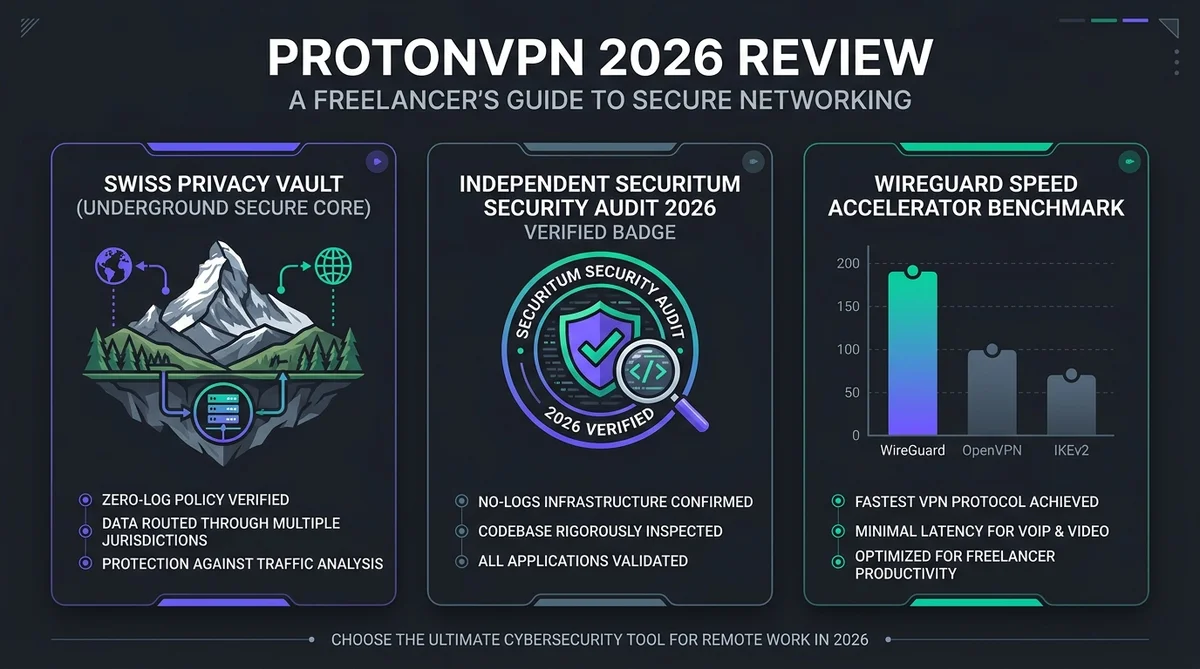
Proton VPN is the undisputed champion of verifiable privacy. Founded by scientists who met at CERN and incorporated in Geneva, Switzerland, Proton VPN is governed by the Swiss Federal Act on Data Protection. Every single client app (macOS, Windows, Linux, iOS, Android) is 100% open source and publicly audited by Securitum. If you manage confidential client NDA material, investigative reporting, or sensitive legal files, Proton VPN is the most trustworthy tool in the category.
The trade-off is pricing and a slightly more technical learning curve. At about $3.49/month on a 2-year plan, it is more expensive than Surfshark and CyberGhost. While its “VPN Accelerator” technology keeps WireGuard connections snappy, its specialized Secure Core double-hop routing introduces inherent latency penalties due to physical distance between underground bunker servers.
1 Technical Specifications: Proton VPN Review Overview
Here is how Proton VPN compares against industry standards across official server infrastructure, legal jurisdictions, and audit frameworks:
| Feature / Criteria | Proton VPN Configuration | Commercial VPN Standard |
|---|---|---|
| Headquarters & Jurisdiction | Geneva, Switzerland (Outside 14-Eyes) | Panama, BVI, or EU/US |
| Source Code Transparency | 100% Open Source (Client apps on GitHub) | Closed Proprietary Source |
| Security Audits | Securitum (Apps & No-Logs verified) | Big Four Accounting Audits |
| Global Server Fleet | 20,000+ servers in 140+ countries | 3,000 to 6,000 servers |
| Core Protocols | WireGuard, OpenVPN, Stealth (Obfuscated) | WireGuard & OpenVPN |
| Multi-Hop Defense | Secure Core (Swiss/Icelandic military bunkers) | Standard Double VPN server pairs |
| Simultaneous Connections | 10 Devices (Plus Tier) | 6 to Unlimited Devices |
| Free Version Available | Yes (Unlimited data, 10 free locations) | Data-capped or ad-supported |
| Starting Price (2-Year Plan) | ~$3.49 / month | $2.19 to $3.09 / month |
| Money-Back Guarantee | 30 Days (full refund, first purchase) | 30 Days full refund |
2 Is Proton VPN Safe? Swiss Privacy Law & Open Source
When remote professionals evaluate a Proton VPN review, the legal jurisdiction is the primary selling point. Switzerland is internationally recognized as one of the world’s most defensive legal environments for personal data.
The Swiss Legal Shield (FADP)
Proton AG is headquartered in Geneva and governed by the Swiss Federal Act on Data Protection (FADP) and the Swiss Federal Constitution (Article 13). Switzerland is not a member of the European Union, nor is it signatory to the 5 Eyes, 9 Eyes, or 14 Eyes intelligence alliances.
Under Swiss law, VPN service providers are not classified as major telecommunications operators. Therefore, Proton VPN has no statutory obligation to store connection timestamps, allocated IP addresses, or browsing metadata. An overseas agency seeking user records cannot simply serve a subpoena. They must petition the Swiss Federal Department of Justice and Police, and requests are routinely denied unless they involve severe criminal acts recognized under the Swiss Penal Code.
100% Open-Source Code on GitHub
Nearly all commercial VPN providers claim to respect your privacy, but their desktop applications remain closed-source compiled binaries. You have no way of knowing whether a client secretly writes telemetry logs or embeds third-party analytical trackers.
Proton VPN took the rare step of open-sourcing all its client applications. Anyone can inspect the code directly on the Proton VPN open-source repositories. Independent cybersecurity consultancy Securitum performs regular code audits and penetration tests on these apps, publishing the audit reports publicly with zero redactions.
In an industry built on trust, Proton VPN is one of the very few services that offers mathematical and legal proof rather than empty marketing promises.
3 Secure Core: Underground Bunker Routing
Standard VPN connections route your traffic directly to an exit server in your chosen country. If that exit server is compromised by a hostile actor or government wiretap, correlation attacks could theoretically match incoming encrypted traffic to outgoing unencrypted requests.
Proton VPN mitigates this threat with Secure Core. Before your traffic reaches your desired destination country (e.g., the US or UK), it is first routed through an intermediary server owned and operated exclusively by Proton in hardened, privacy-friendly jurisdictions:
- Switzerland: Housed in a decommissioned Swiss military command bunker 1,000 meters underground in the Alps.
- Iceland: Installed in a secure former military base running on 100% renewable geothermal energy.
- Sweden: Located in an underground datacenter outside Stockholm.
Because Proton owns the hardware and network routers in these entry facilities, an adversary monitoring the final exit server cannot trace the connection back to your real IP address. The trade-off is latency: routing traffic through a Swiss bunker before exiting in New York adds physical packet travel time.
4 Proton VPN Review: Speed, WireGuard & VPN Accelerator
Early iterations of ProtonVPN relied heavily on OpenVPN, which resulted in sluggish throughput. Today, Proton defaults to clean WireGuard implementations paired with proprietary routing optimizations called VPN Accelerator.
How VPN Accelerator Functions
VPN Accelerator is a set of technologies designed to overcome the CPU and TCP constraints that bottleneck VPN tunnels:
- Multi-core packet processing: Standard OpenVPN runs as a single-threaded process. VPN Accelerator splits traffic processing across multi-core server processors, preventing single-core CPU saturation.
- Advanced TCP congestion control: It replaces legacy TCP algorithms with BBR (Bottleneck Bandwidth and RTT), reducing retransmissions over lossy Wi-Fi connections.
- Direct server peering: Proton connects directly to major internet exchange points (IXPs) rather than renting transit through overloaded commercial brokers.
In day-to-day use, domestic WireGuard connections are fast enough for uninterrupted 4K streaming, massive Git repo synchronization, and low-latency Zoom video conferencing. However, when Secure Core is toggled on, ping times increase noticeably—making it ideal for confidential document handling, but less suited for competitive gaming.
5 Proton VPN Free: The Only Trustworthy Free VPN?
Most “free” VPNs are dangerous data-harvesting operations that sell your browsing habits to third-party ad networks or inject affiliate cookies into your browser sessions. Proton VPN Free is the rare exception.
Proton operates its free tier as a freemium acquisition model supported by paid Proton Plus subscribers:
- Zero bandwidth limits: You can browse, download, and stream without artificial 500MB monthly caps.
- Zero activity logs: Governed by the exact same Swiss no-logs policy as paid tiers.
- Zero third-party ads: The client interface has no pop-up advertising.
The limitations of the free tier are sensible: you are assigned automatically to servers in 10 free locations (Netherlands, Japan, Romania, Poland, Norway, Switzerland, Singapore, Mexico, Canada, and the United States), connection speeds are capped during peak hours, and advanced features like Secure Core, P2P torrenting, and dedicated streaming unblocking are reserved for Plus subscribers.
6 Proton VPN Price in 2026: Plans & Value
Proton VPN is priced at a premium compared to high-volume commercial competitors. These are the prices listed on Proton’s pricing page as of October 25, 2026:
| Subscription Tier | Effective Monthly Cost | Key Inclusions |
|---|---|---|
| Proton VPN Free | $0.00 | 1 device, medium speed, 10 free locations |
| Proton VPN Plus (1 Month) | $9.99 / mo | 10 devices, max speed, all 20,000+ servers |
| Proton VPN Plus (2 Years) | ~$3.49 / mo | Billed $83.76 for the first 24 months, then renews at $83.88 per year |
| Proton Unlimited (2 Years) | ~$7.99 / mo | VPN + Proton Mail + Drive + Pass. Billed $191.76 for the first 24 months, then $119.88 per year |
Proton also sells a 1-year plan, but its price moves with promotions, so check the pricing page before you buy. Watch the renewal price too: after the first 24 months, Plus renews at $83.88 per year, which works out to about $6.99 per month.
Note on Refunds: According to Proton’s terms, you get a full refund if you cancel within 30 days of your initial purchase. Refunds are limited to once per user, and payments made by cash or bank transfer aren’t refundable.
7 Proton VPN Review: Strengths & Trade-Offs
Key Strengths
- Swiss FADP Jurisdiction: Strongest legal privacy protections globally.
- 100% Open-Source Clients: Audited publicly by Securitum on GitHub.
- Secure Core Multi-Hop: Routes through Swiss and Icelandic military vaults.
- Unlimited Free Plan: No data caps, no logging, and zero injected ads.
- Stealth Protocol: Bypasses deep packet inspection (DPI) in hostile networks.
Key Trade-Offs
- Higher Price Point: ~$3.49/mo on the 2-year plan, more than budget rivals like Surfshark.
- Secure Core Latency: Multi-hop bunker routing adds measurable latency.
- Renewal Price Jump: after 24 months, Plus renews at $83.88/year (about $6.99/mo).
- Weak Trustpilot Score: 2.1/5, mostly over billing, refunds and support.
8 What Do Real Users Say? Proton VPN Trustpilot Rating Explained
When evaluating whether a security tool is dependable in daily practice, customer review platforms offer an essential reality check. On Trustpilot, Proton VPN holds a TrustScore of 2.1/5 (‘Poor’), based on about 1,021 reviews as of October 2026. Its profile also shows that Proton replied to 100% of negative reviews. For a service with a prominent reputation for security, that rating immediately prompts the question: is Proton VPN safe, or are there hidden operational flaws?
Examining the individual feedback reveals a distinct division between technical security and account administration:
- Billing and cancellation friction: Most negative reviews focus on difficulties with subscription renewals, cancellation requests, or refund disputes.
- Customer support responsiveness: Users report delayed responses during peak periods when dealing with support ticket queues.
- Connection stability: Some reviewers report dropped connections or apps that fail to connect, mostly on Windows.
- Free-tier server congestion: Periodic connection drops or slow speeds on free-tier servers during peak global usage hours.
- Ease of use and privacy praise: Conversely, positive reviews consistently praise the intuitive interface across apps and Proton’s strict privacy standards.
This operational gap is critical to understand: customer complaints largely involve customer support, refunds, and billing logistics rather than compromised encryption or privacy leaks. On the privacy and security side, Proton VPN’s foundation remains solid: the company is headquartered in Switzerland under Swiss privacy laws, all apps are open source, and its strict no-logs policy has been independently audited by Securitum.
For freelancers and remote workers, the practical recommendation is straightforward: test the infrastructure before committing long-term. You can begin on the free plan—which provides unlimited bandwidth with zero ads and servers across 10 countries—or evaluate the Plus plan (about $3.49/month on the 2-year plan) with the 30-day refund window. To prevent recurring renewal friction, cancel directly from your Proton account dashboard rather than relying on email support.
Frequently Asked Questions: Proton VPN Review (2026)
Is Proton VPN really safe and private?
Yes. Proton VPN is headquartered in Geneva, Switzerland, operating strictly outside Five/Nine/Fourteen Eyes intelligence alliances and governed by the Swiss Federal Act on Data Protection (FADP). Its client applications are 100% open source on GitHub, and its strict no-logs policy and apps undergo continuous independent verification by European cybersecurity auditor Securitum.
How does Proton VPN’s free plan work, and is bandwidth truly unlimited?
Proton VPN Free provides unlimited data with no monthly caps. Speed is listed as ‘Medium’ on Proton’s pricing page, and free servers can slow down during peak hours. It allows 1 device connection and automatically routes traffic through servers in 10 free locations (Netherlands, Japan, Romania, Poland, Norway, Switzerland, Singapore, Mexico, Canada, and the United States). Unlike shady free VPNs, it displays zero advertisements, sells no user data, and is financed entirely by paid subscribers.
What is Proton VPN Secure Core architecture?
Secure Core is Proton VPN’s double-hop privacy architecture that defends against advanced network surveillance. Before your traffic reaches an exit server in your destination country, it routes through hardened, dedicated servers located in underground military bunkers and secure datacenters in privacy-friendly jurisdictions: Switzerland, Iceland, and Sweden.
How many devices can connect to Proton VPN Plus, and does it support streaming?
Proton VPN Plus supports up to 10 simultaneous device connections across Windows, macOS, Linux, Android, iOS, and compatible routers. The Plus plan unlocks all 20,000+ servers in 140+ countries, streaming support (Proton lists Netflix in 26 countries), P2P BitTorrent support, and the NetShield ad/malware blocker.
How much does Proton VPN cost in 2026, and is there a refund guarantee?
As of October 2026, Proton VPN Plus costs about $3.49 per month on the 2-year plan ($83.76 for the first 24 months, then $83.88 per year) or $9.99 on a monthly subscription. A 1-year plan is also available at a promo-dependent price. Proton’s terms give a full refund if you cancel within 30 days of your initial purchase (once per user; cash and bank transfers excluded).
What is Proton VPN’s Trustpilot rating?
Proton VPN holds a TrustScore of 2.1/5 (‘Poor’) on Trustpilot, based on about 1,021 reviews as of October 2026. The negative reviews mostly center on billing, refund processing, customer support delays, connection drops, and slow free-tier server speeds, while positive feedback highlights ease of use and Proton’s privacy reputation. Importantly, the complaints reflect administrative friction rather than security flaws, as Proton VPN maintains open-source apps and an independently audited no-logs policy by Securitum under Swiss jurisdiction.
Is Proton VPN legit?
Yes. Proton VPN is run by Proton AG, the Geneva-based company behind Proton Mail. Its apps are open source, and its no-logs policy has been audited by Securitum. The complaints users raise are about billing, support and connection issues, not about the service being a scam. Its Trustpilot score was 2.1/5 in October 2026, mostly for those reasons.
Is Proton VPN Free safe to use?
Yes. The free plan runs under the same no-logs policy as the paid plans, shows no ads and has no data cap. The limits are practical: 1 device, medium speed, 10 server locations, and no streaming, P2P or Secure Core.
Does Proton VPN work with Netflix?
On paid plans, yes. Proton says streaming is available on all paid plans and lists Netflix in 26 countries, including the US, UK, Canada, France, Germany and Japan. The free plan doesn’t support streaming. Streaming services change their VPN blocks often, so results can vary.
Is Proton VPN worth it in 2026?
It is if privacy is your priority: Swiss jurisdiction, open-source apps, an audited no-logs policy and Secure Core routing. At about $3.49 per month on the 2-year plan, renewing at $83.88 per year, it isn’t the cheapest option. If you only want a low-cost VPN for streaming, a budget rival may suit you better. You can try it first with the free plan or within the 30-day refund window.
9 The Final Proton VPN Review Verdict: Should You Buy It?
To conclude this Proton VPN review, here is the decisive recommendation for remote workers in 2026:
Buy Proton VPN if: You care deeply about verifiable transparency and Swiss legal immunity. If you handle confidential client IP, sensitive legal or financial audits, or simply refuse to trust closed-source VPN binaries owned by marketing conglomerates, Proton VPN is the most principled, technically sound product on the market. Furthermore, if you already use Proton Mail, upgrading to the Proton Unlimited bundle is an exceptional productivity play.
Skip Proton VPN if: You are shopping strictly on price, or want a simple plug-and-play VPN for entertainment streaming. If your main goal is connecting fifteen devices for two dollars a month, Surfshark offers far more hardware flexibility for less than half the cost.
