01Agencies Are Actively Debating This
A Reddit thread in r/marketing asks agencies directly: are you using AI, and if so, are you disclosing it to clients? The responses show a fractured industry: some agencies disclose transparently and frame AI use as a productivity advantage that reduces client turnaround times; others keep quiet for fear that clients will demand discount pricing or question the value of human strategic oversight.
For independent freelancers, establishing a clear policy for AI disclosure to clients creates a strategic competitive advantage. Clear, professional communication around how you deploy AI separates experienced professionals from low-tier operators attempting to pass off unedited chatbot drafts as premium consulting.
02Why AI Disclosure to Clients Matters
Fourscore Business Law’s analysis of commercial transparency explains that formal AI disclosure to clients protects trust, confidentiality, and liability: when clients discover undisclosed AI use after delivery, the breach of trust often permanently damages the business relationship — even if the deliverable was technically competent.
Furthermore, if your contract contains standard intellectual property warranties certifying that all work is “100% original human authorship,” undisclosed AI generation can inadvertently constitute a material breach of contract, complicating copyright transfer under current US Copyright Office guidelines.
03When to Handle AI Disclosure to Clients: At Intake
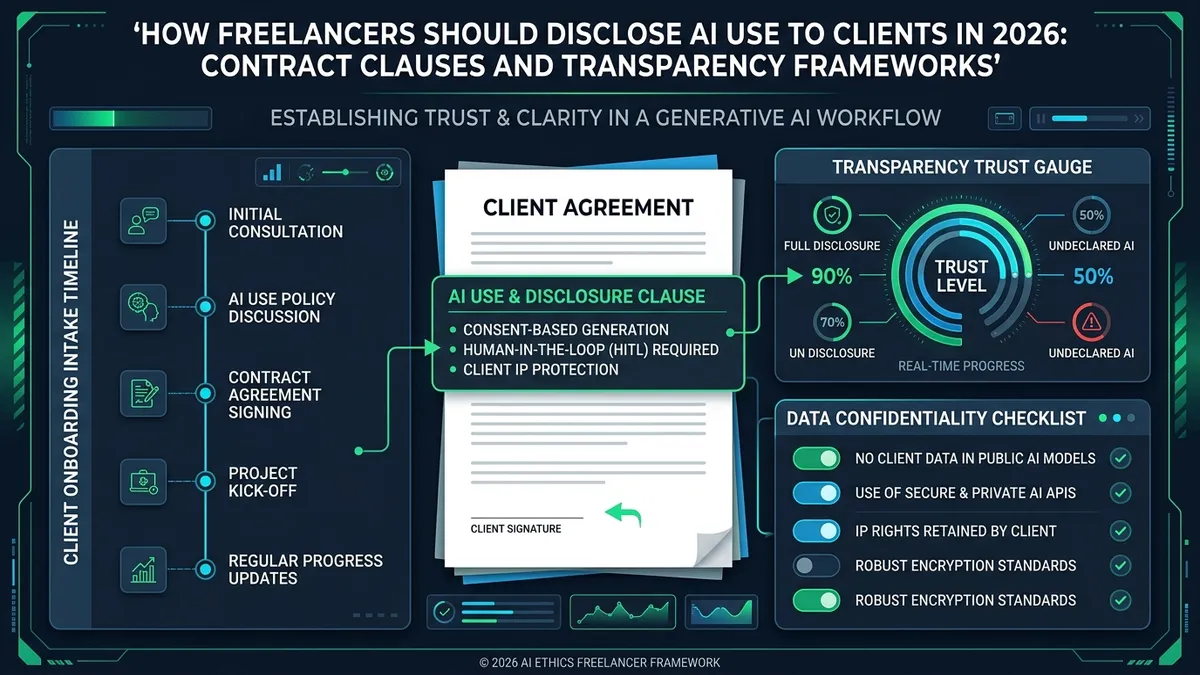
The American Bar Association’s guidance on disclosing AI to clients identifies intake as the optimal moment to address technology standards: written directly into engagement letters and onboarding documents, before project work begins.
Standardizing your protocol for AI disclosure to clients during project intake eliminates friction early: it’s treated as an operational policy rather than an admission or afterthought. A client who knows upfront that you use ChatGPT Plus or Claude for research and outline generation expects rapid iteration, while resting assured that you personally verify all facts.
“The most defensible protocol for AI deployment is proactive transparency at client intake, securing written consent within the engagement agreement while explicitly defining human verification safeguards.”
American Bar Association: Legal Technology & Client Communication Ethics 2026
04Mounting Legal Pressure
Esquire Solutions’ review of commercial legal standards shows that formal AI disclosure to clients is rapidly transitioning from a best practice into an enterprise requirement. In legal practice, Pennsylvania already requires formal AI disclosure; across Europe, the EU AI Act enforces strict transparency obligations for synthetic content.
While freelance design, marketing, and software engineering aren’t subject to courtroom rules, enterprise clients are rapidly updating their vendor procurement contracts to mirror these standards. Freelancers who already have transparent disclosure frameworks in place win enterprise contracts faster.
05Contract Language to Consider
Some freelancers now include a standard clause noting that AI tools may be used to assist drafting or research, with all final deliverables reviewed and approved by the freelancer before delivery — directly mirroring the ABA’s intake-stage recommendation above.
This kind of clause turns AI disclosure to clients from an awkward one-off conversation into a standard, low-friction part of onboarding — set once in a contract template and reused for every new client without having to raise the subject verbally each time.
Model Engagement Clause: AI Disclosure to Clients in Contract SOW
“Contractor utilizes modern computer-aided tools, including generative artificial intelligence, for preliminary research, structural drafting, and ideation. Contractor certifies that all final deliverables are personally curated, verified, and refined by Contractor, ensuring complete factual accuracy, copyright compliance, and alignment with Client brand standards. No confidential Client data shall be submitted to external AI models without prior consent.”
“Contractual transparency regarding machine assistance preserves professional fiduciary trust. The liability rests not in the software utilized, but in the fidelity of human oversight.”
Fourscore Business Law: Commercial AI Ethics & Fiduciary Guidelines
06Frequently Asked Questions
When is the best time to disclose AI use to a client?
At intake, according to the American Bar Association’s 2026 guidance, ideally written directly into the engagement agreement or statement of work before project kickoff.
Is AI disclosure becoming a legal requirement, not just best practice?
In some jurisdictions and regulated sectors, yes. Pennsylvania requires attorneys to disclose AI usage, and the EU AI Act enforces transparency for generated media. Enterprise client procurement terms increasingly mandate explicit vendor disclosure.
Do most agencies actually disclose AI use today?
It remains an active debate across the creative industry. Top-tier agencies increasingly disclose AI use to emphasize rapid turnaround and sophisticated tooling, while budget shops often hide it out of fear that clients will demand price cuts.
Can disclosure ever hurt me?
Rarely, when framed correctly around quality and human oversight. Clients hire freelancers for outcomes, reliability, and judgment. Explaining that AI accelerates first drafts while you guarantee quality builds respect and prevents contract friction.
Final Verdict: Lead With Transparency, Deliver With Human Quality
Proactive, clear AI disclosure to clients at the intake stage protects freelancer-client relationships, sets healthy project expectations, and establishes you as a modern, trustworthy professional. When you frame AI as an efficiency engine backed by rigorous personal quality assurance, clients view your workflow as a competitive advantage.