Deploying rigorous VPN security forms the foundational network perimeter for remote freelancers, encrypting untrusted Wi-Fi connections, shielding DNS metadata, and isolating sensitive client deliverables from eavesdropping.
Verify whether your active VPN encryption tunnel exposes your real IPv4, IPv6, or DNS requests to local network sniffers and client servers. 100% in-browser, zero telemetry stored.
Test My Connection for Leaks →Select your remote work style to evaluate your primary network risk profile:
| VPN Provider | Core Protocol | Server Architecture | No-Logs Audit | Monthly Cost | Best Freelance Use |
|---|---|---|---|---|---|
| NordVPN | NordLynx (WireGuard) | RAM-only Diskless | PwC / Deloitte (4x) | $3.09/mo | Overall #1 Freelance Pick |
| ProtonVPN | WireGuard / OpenVPN | Secure Core (Swiss) | Securitum (Annual) | $4.99/mo | Maximum Privacy • Open Source |
| Surfshark | WireGuard | RAM-only 10Gbps | Deloitte (2x) | $2.19/mo | Budget Value • Unlimited Devices |
| ExpressVPN | Lightway | TrustedServer (RAM) | KPMG / Cure53 | $6.67/mo | Global Speeds • Travel Router |
| CyberGhost | WireGuard | NoSpy Dedicated | Deloitte | $2.03/mo | Streaming • Dedicated IP |
01 How Online Data Security and VPN Tunneling Work
Whenever you connect your laptop to an internet connection without encryption, your traffic travels through an open digital pipeline. Your local Internet Service Provider (ISP), coffee shop router administrator, or local eavesdropper can intercept your unencrypted DNS queries and see every domain you visit.
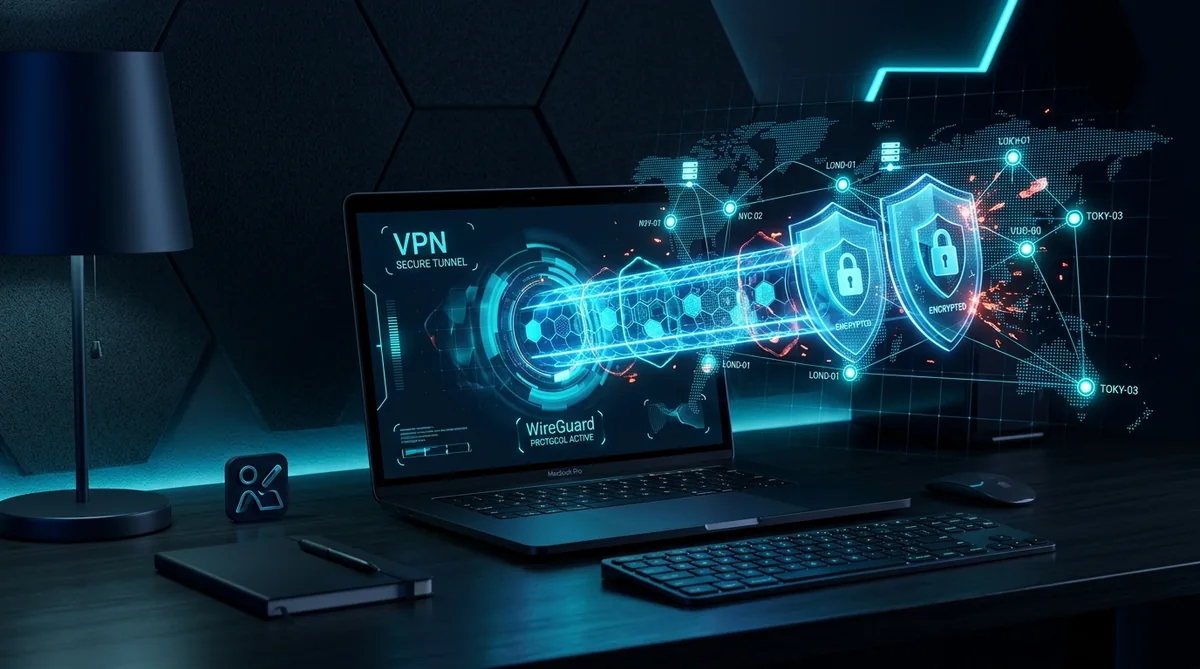
Establishing robust VPN security resolves this vulnerability through cryptographic tunneling. A Virtual Private Network creates an encrypted connection between your device and a remote server. As standardized in NIST AES-256 Specifications, incoming and outgoing packets are encapsulated with military-grade ciphers.
To anyone monitoring the local network, your activity resembles an incomprehensible stream of random hexadecimal data. Furthermore, as the Electronic Frontier Foundation (EFF) emphasizes in its surveillance self-defense guide, a VPN conceals your physical IP address from client tracking servers, preventing third-party profiling.
02 VPN Protocols Compared: WireGuard vs. OpenVPN vs. IKEv2
The underlying cryptographic protocol dictates both connection stability and network latency. Modern VPN security benchmarks evaluate four primary protocols:
Utilizes ultra-clean code (approx 4,000 lines vs OpenVPN’s 100,000) and ChaCha20 encryption. Delivers instantaneous connections and maximum bandwidth. Documented at WireGuard.com.
The open-source pioneer. Highly configurable and capable of bypassing restrictive corporate firewalls over TCP port 443, but incurs higher battery drain on mobile laptops.
Excels at maintaining uninterrupted tunnel connections when your smartphone or laptop switches between Wi-Fi hotspots and cellular 5G networks.
Custom optimizations engineered by NordVPN and ExpressVPN to marry WireGuard’s speed with double-NAT privacy architectures.
03 How We Evaluate VPN Security for Remote Freelancers
Consumer marketing frequently emphasizes streaming unblocking over genuine operational safety. Our testing framework evaluates VPN security through an uncompromising professional lens:
- Independently Audited No-Logs Policy: The provider must submit its infrastructure to regular public audits by top accounting firms (PwC, Deloitte) proving that connection timestamps, IP addresses, and bandwidth logs are never recorded.
- Diskless RAM-Only Servers: Servers must run purely in volatile memory. If physical hardware is seized or powered off, all operational session data vanishes instantly.
- Hardware Kill Switch Reliability: The desktop client must instantly sever internet access if the VPN tunnel drops, preventing IP leakage during Wi-Fi reconnects.
- Compliance with Technical Standards: Guidance aligned with NIST Special Publication 800-113 for Dual-Use Security.
04 Leading VPN Providers at a Glance
While dozens of consumer VPNs exist, only a small handful satisfy professional VPN security standards for remote client management:
| Service | Jurisdiction | Simultaneous Connections | Audited Log Status |
|---|---|---|---|
| NordVPN | Panama | 10 Devices | Verified by Deloitte (2024) |
| ProtonVPN | Switzerland | 10 Devices | Verified by Securitum (Annual) |
| Surfshark | Netherlands | Unlimited Devices | Verified by Deloitte (2023) |
| ExpressVPN | British Virgin Islands | 8 Devices | Verified by KPMG / Cure53 |
05 Choosing a VPN for Your Freelance Workflow
When evaluating your options, selecting the right VPN security provider depends on how you interact with client networks:
For General Remote Contractors: NordVPN provides the most reliable balance of high-throughput WireGuard speeds, automated threat protection against phishing links, and extensive server coverage. Read our Best VPN for Freelancers Guide.
For Privacy-Sensitive Roles & Journalists: ProtonVPN operates under strict Swiss privacy laws, features fully open-source audited code, and offers multi-hop routing that routes traffic through underground nuclear fallout shelters.
For Freelancers Managing Team Hardware: Surfshark allows unlimited simultaneous device connections on a single account, making it ideal for solopreneurs testing web designs across multiple tablets, smartphones, and staging rigs.
06 Common VPN Myths Debunked
Misunderstandings about VPN security often lead freelancers into dangerous complacency:
- Myth 1: “HTTPS makes VPNs obsolete.” While HTTPS encrypts message bodies, Server Name Indication (SNI) and DNS queries still broadcast every domain you visit to local network eavesdroppers.
- Myth 2: “Free VPNs are just as good.” Free VPNs monetize by injecting tracking scripts, throttling connection speeds, or selling user bandwidth to data brokers. Never route client work through a free VPN.
- Myth 3: “A VPN makes me 100% anonymous.” If you log into your personal Google or Facebook account through a VPN, those platforms know exactly who you are via session cookies and browser fingerprinting.
07 Setting Up Your VPN for Maximum Freelance Protection
A disciplined approach to VPN security means configuring correct security flags so the tunnel never leaks:
- Activate the System-Level Kill Switch: Ensure the kill switch is set to “Strict” mode so internet traffic stops dead if the connection drops unexpectedly.
- Enable Auto-Connect on Untrusted Networks: Configure the VPN client to automatically initiate encrypted tunnels whenever your laptop connects to non-whitelisted Wi-Fi SSIDs.
- Enforce DNS Leak Protection: Confirm inside app settings that your device exclusively queries the VPN provider’s encrypted private DNS resolvers.
- Enable Split Tunneling for Heavy Backups: Route client browser tabs through the encrypted VPN while letting local NAS backups bypass the tunnel for maximum throughput.
08 Client Data Compliance, NDAs, and Dedicated IPs
Corporate clients frequently include strict VPN security stipulations in their remote service level agreements. If you connect to client AWS staging portals from rotating consumer VPN IP addresses, automated fraud-detection systems may trigger security alerts and lock your account.
To satisfy client compliance requirements, consider acquiring a Dedicated IP Address from your VPN provider. A dedicated IP provides consistent, static geolocation that your client can safely whitelist on their corporate firewalls without compromising your encrypted tunnel. Incorporate this strategy into our Complete Security Stack for Freelancers.
09 VPN vs. Other Security Tools: What Each Actually Protects
True digital resilience requires understanding the boundary of each protective layer:
| Tool Category | What It Protects | What It Cannot Protect |
|---|---|---|
| VPN Security | Network connection, Wi-Fi sniffing, IP address & DNS queries | Weak passwords, phishing links, local device malware |
| Password Manager | Cryptographic vault, master credentials & API keys | Compromised public Wi-Fi networks, drive hardware failure |
| Two-Factor Auth | Account identity, unauthorized login attempts | Data exfiltration after an active session is established |
| Cloud Backup | Historical snapshots, ransomware disaster recovery | Real-time packet interception or stolen master passwords |
10 Can You Make Your Own VPN? The Self-Hosted Reality
Many technical freelancers explore hosting their own WireGuard server on a cloud VPS (DigitalOcean, Linode, Hetzner). While an engaging technical exercise, commercial VPN security provides distinct advantages over self-hosting:
A self-hosted VPN provides total control over the server environment, but you lose shared IP anonymity — your VPS IP address is registered directly in your name on server billing receipts. For true threat obfuscation, reputable commercial VPN security providers mix your traffic with thousands of concurrent users across distributed server networks.
11 Individual VPN Evaluations & Research Hub
Consult our comprehensive reviews for granular performance tests and protocol benchmarks:
12 Frequently Asked Questions About VPN Security
Do I really need a VPN if I only work from my home office?
Will using a VPN slow down my internet connection noticeably?
Can a VPN prevent hackers from stealing my passwords?
Is it legal to use a VPN for remote freelance work?
Network Defense Verdict: SafeStackPro Standard
An encrypted VPN is your digital armor whenever you leave your home office. By choosing an audited, no-logs provider powered by WireGuard and keeping your kill switch active, you neutralize public Wi-Fi eavesdropping and maintain complete operational confidentiality.

