Notion Review 2026: The All-in-One Freelancer Guide
Affiliate Disclosure: Some links on this page are affiliate links. If you click through and purchase, SafeStackPro may earn a commission — at no extra cost to you. Our editorial recommendations are independent and based on research, not compensation.
Workspace Review2026 Productivity Audit⏱️ 14 min readUpdated: September 2026
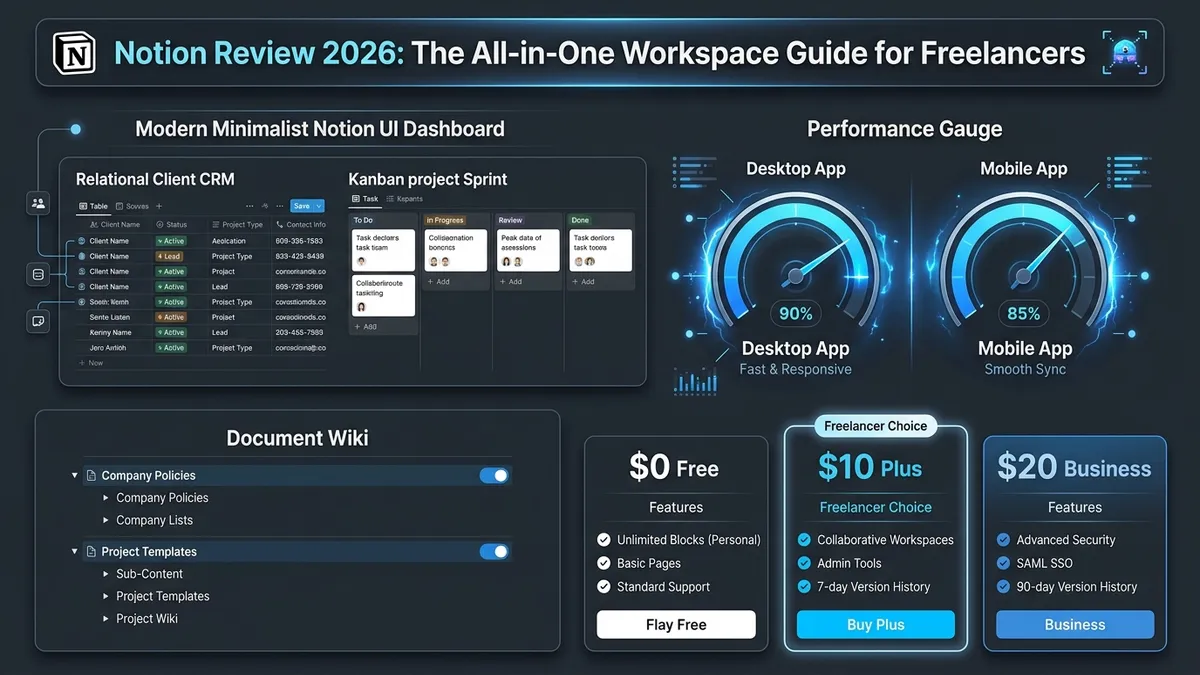
Quick answer: Notion trades a steep setup curve for long-term flexibility — docs, wikis, and project databases in one connected workspace instead of five separate apps. The catch: full AI features (Notion Agent, AI Meeting Notes) require the $20/month Business plan, not the cheaper Plus tier, and the mobile apps have documented lag and sync issues, worse on Android.
⚡ Freelance Stack Matcher
Find the Ideal Project Management & Workspace Platform
Compare relational databases, Kanban boards, client guest portals, time tracking, and team pricing tiers across the top productivity platforms.
Notion isn’t slow or buggy — it’s just unopinionated. Unlike a task app that tells you where your to-dos go, Notion gives you a blank page and expects you to build the system yourself. That’s either liberating or paralyzing, depending on how much time you want to spend organizing your work rather than actually doing it.
For freelancers, that setup time is unbillable. If you spend two full days tweaking views, building custom database relations, and color-coding tags, you need to be confident the system will save you more time over the next year than it consumed upfront. For complex client operations, it often does. For a simple freelance writer or developer with three steady retainers, it rarely does.
02Key Features
Docs, wikis, and project databases — all live in one connected workspace rather than fragmented tools.
Flexible database views — toggle effortlessly between Table, Kanban Board, Calendar, Timeline, and Gallery views for the same data.
Relational databases — link your Client CRM directly to Project Tasks, Invoices, and Meeting Notes.
Granular page permissions & Guest access — invite up to 100 external clients to view or edit specific project portals for free.
Templates ecosystem — thousands of pre-built community frameworks for freelance project tracking and client onboarding.
03What This Looks Like in Practice
Freelancers commonly use Notion as a combined client CRM, project tracker, and knowledge base — keeping project briefs, meeting notes, invoice trackers, and deliverable links connected across one database structure rather than scattered across Google Docs, Trello, and a spreadsheet.
When an active client asks for a status update on a specific milestone, you don’t scramble across email threads: you open their portal page where the live database automatically reflects completed tasks, deliverables in review, and outstanding assets.
“Notion’s relational database architecture provides immense desktop flexibility, but hybrid cloud caching creates noticeable mobile app latency and offline synchronization bottlenecks, particularly on Android devices.”
This Notion review is based on hands-on use of Notion for real client work, cross-checked against Notion’s own documentation and long-term user feedback from Reddit and Trustpilot — not just Notion’s marketing. Where independent user reports and the day-to-day experience of using it agreed, like the steep setup cost paying off only after real structure is built, we treated that as the stronger signal.
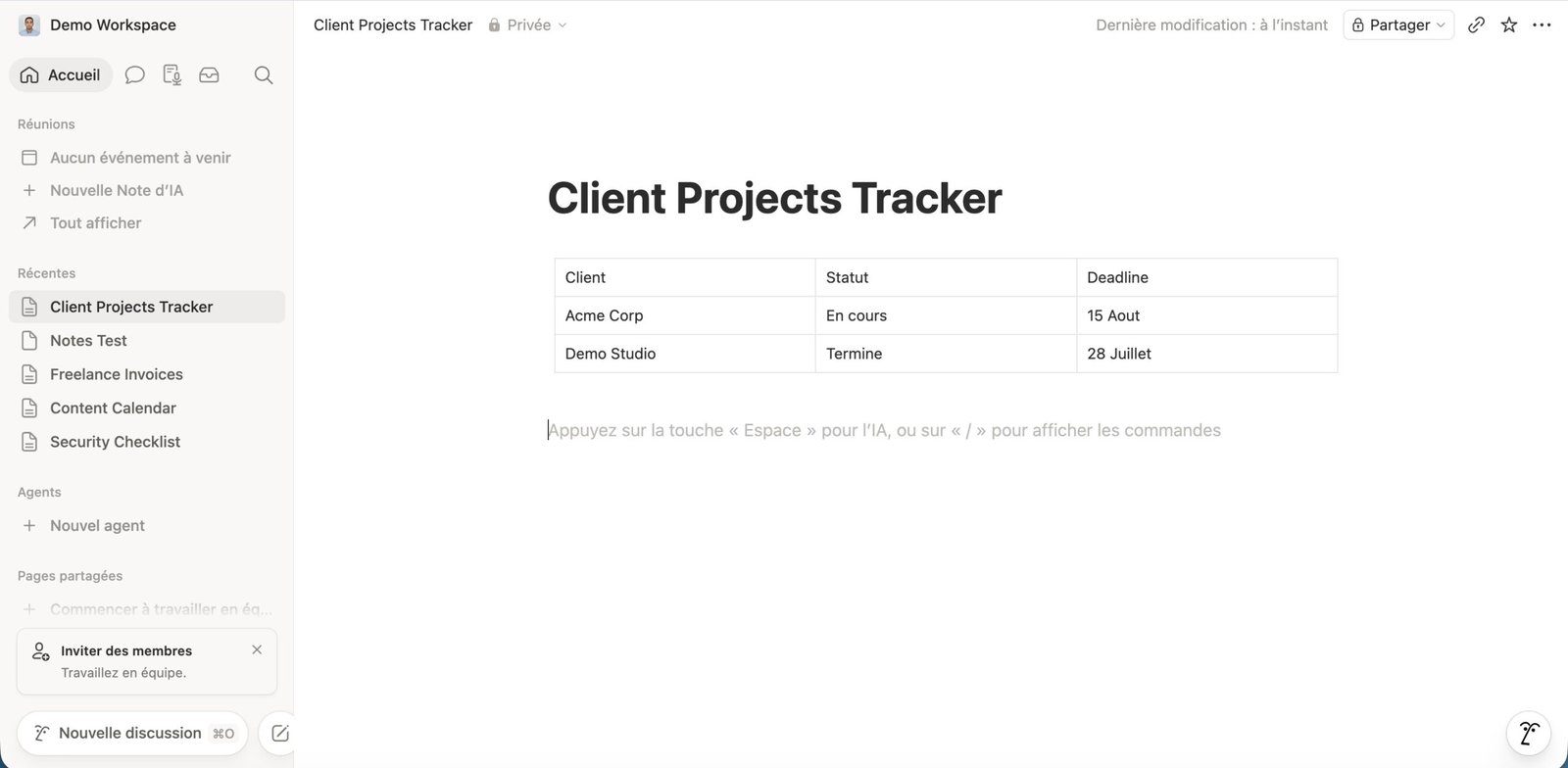
A Notion workspace set up with demo pages and a simple project tracker table, built during this review
05Known Limitations
The learning curve is real — expect to spend real hours (not minutes) building a system that actually fits your workflow. If you want something that works straight out of the box with zero configuration, ClickUp or a simpler tool like Trello is a better fit.
Mobile app performance has been a consistent weak spot: cold starts can be sluggish, heavy database pages stutter when scrolling on mid-range phones, and offline editing remains fragile compared to native notes apps like Apple Notes or Obsidian.
Finally, Notion’s full AI features (Notion Agent, Meeting Summaries) require upgrading to the $20/month Business tier, meaning Plus subscribers don’t get autonomous AI workflows included in their base plan.
📌 Topic Takeaways: Overcoming the “Notion Productivity Trap”
Build Only What You Need: Never spend days designing an elaborate aesthetic dashboard before you have real client projects to populate it. Start with a simple 3-column table and expand organically.
Desktop-First Workflow: Treat Notion primarily as your desktop command center. For rapid mobile note capture on the go, use Apple Notes or Google Keep, then batch-transfer into Notion weekly.
Backup Your Workspace: Notion does not offer native point-in-time local backups. Regularly export your full workspace as Markdown/HTML or CSV to prevent accidental loss of client records.
However, compliance is a shared responsibility: Notion is the data processor, but you are the data controller. Enterprise certifications don’t protect you if you accidentally configure a client’s confidential strategy page with public link-sharing enabled. Always audit sharing settings before sending portal links.
07Pricing & Plan Breakdown
Notion runs four tiers in 2026: Free ($0), Plus ($10/user/month billed annually, $12 billed monthly), Business ($20/user/month billed annually, $24 billed monthly), and Enterprise (custom). The tier that actually matters for AI: full Notion AI access — including the multi-step Notion Agent and AI Meeting Notes — moved to the Business plan; Free and Plus only get a limited AI trial.
Tier Plan
Annual Price
Monthly Price
File Uploads
Version History
Free
$0
$0
5MB per file
7 days
Plus
$10 / user / mo
$12 / user / mo
Unlimited
30 days
Business
$20 / user / mo
$24 / user / mo
Unlimited
90 days
💡 The Guest vs Member Cost Math: Save $240/Year Per Collaborator
Member ($10–$20/mo): Has full access to workspace teamspaces and can create top-level pages. Only add business partners as Members.
Guest (100% Free): Can view and edit specific shared pages, comment on tasks, and upload assets. Always assign clients, VAs, and subcontractors as Guests.
“Consolidating fragmented documentation, task tracking, and client wiki systems into a unified relational architecture generates an average 22% reduction in administrative context switching for knowledge workers.”
Extremely flexible — adapts to docs, projects, client portals, or relational CRMs.
One connected workspace replaces multiple disjointed SaaS subscriptions.
Free plan is genuinely usable indefinitely for solo freelancers.
Vibrant community template library slashes initial setup time.
❌ The Cons
Steep initial learning curve compared to rigid out-of-the-box tools.
Mobile app performance exhibits noticeable lag and sluggish sync on Android.
Full Notion AI Agent features locked behind the $20/mo Business plan.
No native offline point-in-time automated backup system.
09Notion Reviews: The Short Version
Across independent Notion reviews, the consensus is consistent: Notion is the most flexible all-in-one workspace available, but that flexibility comes with a real setup investment. If you’re willing to spend the hours needed to build a system that matches how you work, it pays off in long-term clarity. If you want something that just works out of the box with zero tinkering, look at simpler alternatives.
10Frequently Asked Questions
Is Notion overkill for a solo freelancer?
It can be, if your needs are simple. A single freelancer tracking a handful of clients may get more value from a lighter tool. Notion starts earning its keep once you’re juggling multiple clients, recurring deliverables, and a project knowledge base you need to query quickly.
Can I import templates instead of building from scratch?
Yes. Notion has a vast community and official template library that significantly reduces setup time for common use cases like client CRMs, content calendars, or project trackers. Modifying an existing template is consistently faster than building from a blank canvas.
Does the free tier cover real freelance use?
The free tier is workable for light solo use, but active freelancers managing multiple clients typically upgrade to Plus ($10/mo) for unlimited file uploads, 30-day page version history, and up to 100 guest invites.
Is Notion’s AI included in the cheaper plans?
No. Full Notion AI, including the autonomous Notion Agent and AI Meeting Notes, requires the Business plan at $20/user/month. Free and Plus plans only include a very limited trial.
Is Notion good, and is it actually worth it for freelancers?
Yes, for freelancers juggling docs, wikis, and project tracking across multiple clients — the payoff is consolidation. It’s less worth it if you just need a simple to-do list where setup time outweighs the benefit.
What are Notion’s main pros and cons?
Pros: unified workspace, flexible relational databases, generous free tier. Cons: steep initial learning curve, mobile app lag on Android, and AI locked behind the $20/mo Business tier.
Final Verdict: 8.5 / 10 — The Ultimate Freelance Command Center
Notion rewards the setup time with unmatched long-term flexibility once your workspace is built. For freelancers managing multi-client retainers, connected databases, and project portals, the $10/month Plus plan is one of the highest-return investments in software. Keep your setup simple, leverage community templates, and manage collaborators as free Guests to avoid unnecessary fees.
Yassine writes about digital security tools as a hands-on user, not a professional lab tester — researching each product through official documentation, independent audits, and real user feedback before recommending it. Holds Google's AI Essentials certificate and two SAP certifications.